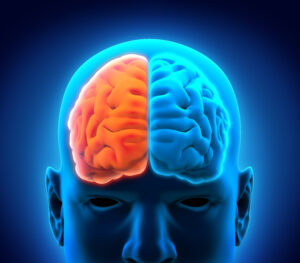
Current scholars in the fields of neuroscience, infant research and relational psychology emphasize that the mechanism of right brain-to-right brain communication is the engine that drives the formation of our most intimate relationships. This mechanism is the essential process through which infants and their mothers form an attachment — either in a healthy or pathological manner — and it determines the template that infants form in their right brains for all future relationships.
Thus, it follows that understanding right brain to right brain communications in adult intimate relationships is critical to understanding their initial attraction to each other and their inevitable conflicts. These communications are nonverbal (except as expressed in tone of voice) and generated primarily in a nonconscious realm. They contain the most critical information for actually knowing a person, and they are the source of most aspects of falling in love, as in infancy.
Right brain to right brain communications are how potential partners learn of each other’s traumatized parts, mostly outside of their conscious awareness. These communications are how they “know” that they have both been harmed in unspoken but similar ways during their childhoods, contributing to both a bond and a dread of “opening Pandora’s box.” Their conflicts are an ongoing attempt to “out” their traumas through the exact words their right brains generate in emotion-laden arguments.
In treatment, therapists discover with their couple clients how to use the seemingly magical, though simple, words repeated during their conflicts as the keys to unlock deeply hidden trauma-driven emotions. An illustration from my own marriage demonstrates right-brain “magic.”
Many years ago my husband and I were rehashing a painful experience between us. At one point, he described my behavior toward him as “mean.” That one word instantly triggered me, and all I could say was “I don’t like that word mean.” I felt scrambled inside, and I couldn’t say any more until I could think. I went to a different room and finally allowed my mind to wander back to memories of my mother using that word to describe my actions toward her in instances when I was only disagreeing with her. For example, she wanted me to agree to wear certain clothing, and when I said I didn’t like it, she accused me of being mean to her. She attributed malicious motives to everything I did to separate from her, causing me to carry a self-image of an unloving person if I dared to be myself.
I wept as I remembered the aching pain in the many moments that my mother had used that word against me. When I finally recovered my ability to talk, I returned to my husband and said, “I don’t know how you knew to use that word ‘mean,’ but you helped me do a piece of grieving I needed to do. Thank you.” And then I shared some of my painful memories. I’m certain that it was our right brain-to-right brain communication that generated that very helpful word.